
Imagine what we could build without ego
Ego does not usually walk into a room announcing itself.
It slips in quietly. Takes a seat. Waits for its moment.
It is the small urge to clarify, “Just to be clear, that was my idea.”
The impulse to correct.
The need to make sure contribution is acknowledged.
Nothing outrageous. Just human.
Yet that instinct can quietly slow down big things.
Because most people genuinely want progress. Better communities. Better workplaces. Better outcomes. The intention is rarely the problem.
The friction usually is.
More often than not, the sticking point is not ambition or high standards. Those things are useful. They sharpen thinking and improve results.
The sticking point is ownership. Credit. Position.
It is the shift from “How do we make this better?” to “Whose idea was it?”
You can feel the moment it happens. Energy tightens. Language changes. Momentum wavers.
We see it everywhere. Even in politics. Long term reform often stalls because it may not be completed within one term of government. The risk that someone else might cut the ribbon can outweigh the desire to start the work at all. When credit becomes part of the calculation, progress shrinks.
And it is not just governments.
I have seen capable teams lose traction over issues that had little to do with the work itself. A missed acknowledgment. A perceived slight. A feeling of being overlooked. The outcome becomes secondary to the need to feel seen.
But I have also experienced the opposite.
Recently, I had the privilege of collaborating with a small group of peers across several visitor economy campaigns designed to support and energise local businesses. The process has been energising and purposeful. One of us throws an idea into the middle. We test it, refine it, improve it. By the time it lands, it barely belongs to one person.
Once it is shared, it is collective.
No one keeps score. No one circles back to claim authorship when it succeeds. What matters is whether it works and the impact it creates, not who said it first.
And when the results land, the success feels shared.
Increased engagement. Greater visibility. Local businesses seeing tangible movement. Momentum that would not have happened in isolation.
None of us cares whose boot scored the goal. We are on the same team, and when it works, everyone wins.
In that kind of environment, ego does not disappear. It simply does not lead. Mutual respect replaces insecurity. Trust replaces defensiveness. The acknowledgment that matters most happens in small moments, not public headlines.
Ego asks, How does this reflect on me?
Purpose asks, Does this move us forward?
Those questions build very different cultures.
Real confidence does not compete for oxygen. It creates space. It understands that shared success is still success. That contribution does not lose value just because it is not individually spotlighted.
The strongest campaigns are built this way. Collaboratively. Without territorial thinking.
Almost everything worth building depends on cooperation. Families. Communities. Businesses. Creative projects. Reform that lasts longer than election cycles.
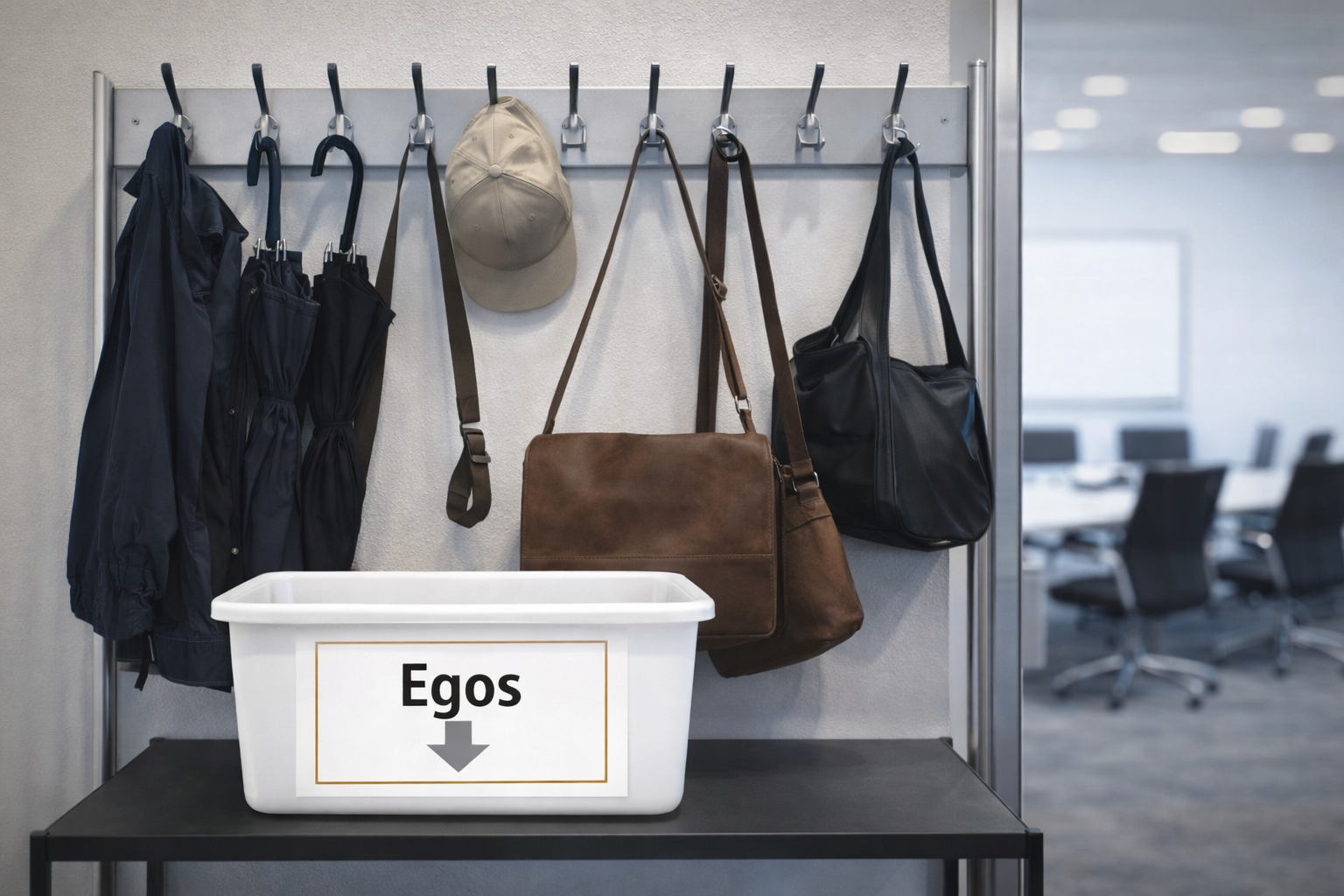
Imagine what we could build if we all parked our ego at the door before stepping inside.